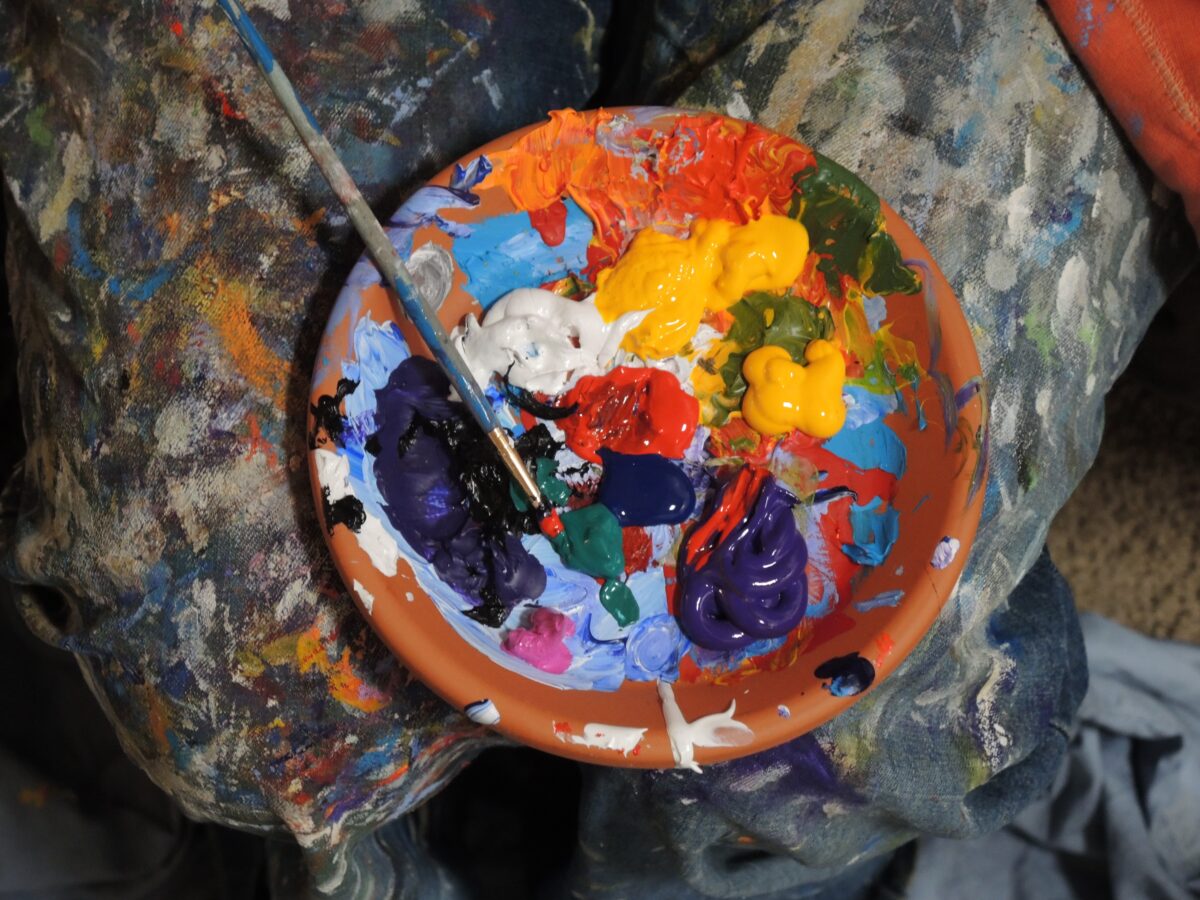
Over April 2nd through 26th I engaged in my sophomore block field work. I was placed in an art classroom and had the opportunity to help in a classroom with a wide range of students from 4k-8th grade. My sophomore block experience helped me move forward as an educator by giving me the opportunity to gain more experience in a classroom setting. Throughout my fieldwork I was given the opportunity to lead lessons and help assist students with their projects. Going forward in my journey as an educator I will be sure to build upon my knowledge that I have learned from my fieldwork placement.
Author: Lily Wangler
Developmentally Appropriate Pedagogy
An art class itself is very different from a traditional classroom from my own experience. Considering that there are a lot of different strategies and developmentally appropriate pedagogies that art educators can use to help better their students. Within my “Developmentally appropriate pedagogy” assignment I chose 3 different strategies that can be implemented in a middle school art class. Self evaluation, Peer critique, and collaboration. Within the assignment I explained how these strategies work and why they work taking stages of theories.
Self evaluation of work, Middle school, Art Education.
Letting students self evaluate their own work helps develop problem solving skills and critical thinking. Within middle school its important to let them review their own work because they are at the stage in their life when they start to be more critical of their own work and themselves.Middle schoolers around this stage in their life are starting to develop reasoning and logic alongside abstract thinking skills. Letting them have the opportunity to evaluate their work will help them develop their critical thinking further. The Apa citation was taken from a music classroom but can be applied in any classroom.In a art classroom this strategy can be applied by allowing students to grade themselves.
Hewitt, M. P. (2011). The impact of self-evaluation instruction on student self-evaluation, music performance, and self-evaluation accuracy. Journal of Research in Music Education, 59(1), 6–20. https://doi.org/10.1177/002242941039154
In Piaget’s Theory of cognitive development at a the concrete operational stage students tend to become critical of their own work and develop problem solving skills. This theory explains why students are able to succeed in self evaluation.
————————————————————————————-
Respectful peer work critique , Middle school, Art Education
Allowing students to respectfully critique each other’s work can be a strategy for improvement overtime. Getting feedback from other students can bring out different perspectives and help you see your ideas from a different angle. Within the developmental stages of middle school students are starting develop their own perspectives and by involving them in feedback they are taking a leadership roles and helping foster their learning. Hearing feedback from peers in middle school might be more effective form of criticism as well for some students because peers may value their peers opinions and perspectives more.
Soep, E. (2004). Visualizing judgment: Self-assessment and peer assessment in arts education. In Handbook of research and policy in art education (pp. 667-687). Routledge.
Within Lev Vygotsky’s theory of Zone of proximal development students potential development can be supported by other peers or under adult guidance at the “assistance provided by others stage.” Sometimes peers or a mentor will be able to give constructive feedback of an artwork that the artist had not thought of. This theory helps explain why constructive feedback helps support students.
——————————————————————————————–
Collaborative learning , Middle school, Art Education
Collaborative learning in a class can be done in different ways. It involves allowing students to work together on a project and collaborate on a creation. In an art class this can be done by a group of students working together to create a mural. Collaborative learning in middle school is essential as it sets up the concept of working together and encourages team building skills. Collaborative learning can also help a students creativity, social skills, and confidence.
Hmelo-Silver, C. E., & Chinn, C. A. (2016). Collaborative learning. In L. Corno & E. M. Anderman (Eds.), Handbook of educational psychology (3rd ed., pp. 349–363). Routledge/Taylor & Francis Group.
Within Selman’s Theory of Interpersonal Understanding at stage 5 of peer work, students are able to come together to solve problems.At this stage Students can also set goals and make important decisions together. This theory explains why collaborations work and are important for middle schoolers.

Developmental theories
Studying different types of developmental theories helps educators understand how children learn. These theories can provide framework within a classroom setting and provide guidance on how to teach students best, using different approaches and strategies. Using developmental theories can make the learning process easier for students as well. Different developmental theories usually have stages to help see where the students are at within the base of the theory. Depending on the students’ ages or where they are placed within the stages of the theory you can build your classroom activities in a way to support all students.
independence
You can support adolescents becoming independent young adults, and productive citizens by setting consistent expectations. Letting students make their own decisions when it comes to some things also helps them become more independent. For example as an art educator for an assignment I hand out a rubric for the assignments expectations but I allow the students to have freedom when it comes to the medium or an element of art. Another way to support adolescents’ independence is letting them grade their project. If I were to do this in the future I would also grade their project and even the scores. Letting students grade their own work gives them room to think critically about their own work and helps them understand the process a bit more, and lets them have more independence.
Observation
Observation helps us understand a students developmental process. By observation we can understand what individual needs each student needs and identify patterns to see how the students learn best overall. Observations also help us see the “norms” of each grade level. Observing students can help you get a better grasp of what those “norms” are. I found an interesting website that breaks down different developmental stages when it comes to art. There are 6 stages in total according to Matt Fussel the author of this article. There is stage one “scribble stage” for ages 1-3, which is pretty self explanatory. Stage 2 “preschematic stage” for ages 3-4. Where children start to learn shapes and incorporate them within their art. Stage 3 “Schematic stage” for ages 5-6. Children start to recognize shapes even more and there’s a clear connection between the ground and the sky in their art. Stage 4 “the dawning realism” for ages 7-9. At this stage children become more critical when it comes to their art. They start to overlap things within their art as well. Stage 5 is “ pseudo naturalistic” from ages 10-13. At this stage the students start to understand values more and use that within their art. Students also become very critical of their art and need lots of encouragement within this stage. Stage 6 is the last stage on this website. “ The decision” for ages 13-16. In this stage the students decide if they want to continue drawing or not. Developmental stages are important because it helps us meet students where they are in learning.
Fussell, Matt. “The Stages of Artistic Development.” Thevirtualinstructor.com, 20 June 2011, thevirtualinstructor
How do you measure a year?
Within the short film “How Do You Measure a Year” Ella Rosenblatt is asked questions each year on her birthday from 2 years old till 18. Every year she answers the questions a bit differently as she cognitively and intellectually develops. When she is younger she is asked what she fears and her first answers involve monsters. Within her preteen years her fears are not fitting in, and not being liked. As Ella gets older her fears change and develop into something bigger. Within her late teen years she fears life. Ella Rosenblatt states she’s afraid of living because with all of the twists, and turns within life she doesn’t know what to expect and that scares her. I find it interesting how her answers develop throughout the years.
Teaching philosophy
Out of the teaching philosophies I scored high in progressivism, and will most likely be using this in the future as an art educator. Progressivism organizes the schools curriculum based real-world experiences, and curiosity of the students. Answers in this type of classroom aren’t found in lists but discovered in the real world. Projects are usually based around the students interests, and classrooms are filled with different materials, books, and software for students to use for research. I believe students should have some freedom when it comes to what they are learning to encourage them to pursue what they want to learn about. In the future I will most likely be teaching at a middle school, and depending on where I teach the school might have a set curriculum that I have to go by, although I will still be able to give my students some freedom within the classroom. For example having the students pick what technique and medium they want to work with. Giving students the option to choose what they want to work on will encourage their creativity, and explore areas of interest. To keep my classroom culturally responsive I can provide different types of art from various artists, of different races, cultures, and gender as examples in my classroom, as well of having different resources available. My classroom will be set up with different resources my students can use for projects, along with different posters to help encourage them such as color wheels, elements of art, anchor charts, and growth mindset posters. I want my students to be able to exceed their goals, and to know that their grades in my class don’t relate to their drawing, and painting skills, although it does depend on the effort and work being put into their art. I want them to understand that mistakes are just a learning process, and they can create anything they put their mind to, with practice. Practice may not make perfect, but it does help focus on your skills, and overtime you will notice change. For class management I would set expectations for my class to follow such as guidelines. I don’t want a set due date for projects to be done within my classroom unless the school itself calls for it, but art does take time and patience. If the majority of the class needs more time to finish, I can add an extension of time for those to catch up, along with letting students work in the art room a few minutes before, and after school, and including time during their study hall periods, if their teacher allows it. Engagement in my class will be centered around the students. At the end of each quarter, every student will present one piece of work, and explain what techniques they used along with the medium, and the meaning behind their artwork. Their peers will then examine the artwork and give feedback. Goals within my courses will be solely based on the students overall goals. Students will set a goal, or something they want to achieve over the year and goals will be addressed to see how the student is doing throughout the year.
These are some links to websites that contribute to my future classroom or just things I look up to.
Social problem
- Now that you have brainstormed the above, if you could solve any ONE social problem, what would it be? What type of career role (title, sector/position) might you want to pursue to accomplish this if not for teaching? How might solving that problem impact the field of Education? (Hint: this last part should fit right into your Educator Impact Statement/Teaching Statement). Please post the response to this in a blog post on your own website.
I would choose to focus on mental health by going into a career of art therapy. Going into a career as an art therapist I would be able to help others by working with clients to develop coping skills or strategies to change behavior through art. Mental health is a big struggle among people today and is a lot more common in students, and I believe all teachers should be trauma informed which is why I picked mental health as a major social problem today.
village project reflection
EDUC 101
Village Project Reflection 1
- Name of school and organization that you are serving.
I’m a volunteer at Anne Sullivan Elementary .
- List the first name of the student, age, and grade of one student you work with the most
or tell me about the whole group of students that you are serving.
I’m working with the K1 classes in their after school program.
- Explain what you are doing during your time at the school.
There’s not an exact schedule because the school is very understaffed but we have some sort of learning, academic time where I read to the kids then we do some sort of activity before it’s pickup time.
- Personal Reflection: How are you feeling about working at this school?
Provide concrete examples and appropriate judgment to explain why you have these feelings.
I like the school although it was overwhelming the first day I volunteered because there were only 2 staff members available when there’s supposed to be at least 8, but besides that I’ve been doing great. Although I’ve had some trouble communicating with some of the students who only speak spanish but i’ve been reviewing my spanish because i only took one class in highschool and know the basics but i want to have conversations with all my students.